
The #1 Best Benefits of Mini Split AC Systems for Your Home

With temperatures getting warmer, many homeowners are starting to think about their cooling needs for the upcoming season. One option that is gaining in popularity is the mini split AC system. This innovative technology offers several benefits over traditional central air conditioning systems, including energy efficiency, easy installation, and zoning capabilities. In this blog, we’ll explore the advantages of mini split AC systems, as well as tips for maintenance and installation.

What is a Mini Split AC System?

If you’re looking for a way to cool your home without the hassle and expense of traditional central air conditioning, then a mini split AC system may be the perfect solution. Mini split AC systems are compact and efficient, with both indoor and outdoor components that work together to provide cool air to your living space.

Unlike traditional central AC systems, mini systems do not require ductwork. Instead, they use a small conduit that connects the indoor and outdoor components. This makes them easy to install and perfect for homes that do not have existing ductwork.

The Benefits of Mini Split AC Systems

Energy Efficiency

One of the biggest advantages of these systems is their energy efficiency. Because they do not require ductwork, there is no air loss, which means that they use less energy to cool your home. Additionally, mini split AC systems use inverter technology, which means that they can adjust their cooling output based on the temperature of the room. This results in even more energy savings and lower utility bills.

Zone Cooling

Mini split AC systems are also great for homes with multiple rooms or zones. Each indoor unit can be controlled independently, which means that you can adjust the temperature in each room to your liking. This eliminates the need to cool the entire home, which can be a waste of energy and money.

Quiet Operation

Mini split AC systems are known for their quiet operation. Unlike traditional window AC units, mini split AC systems have the compressor located outside of the home, which means that they produce less noise inside. Additionally, the indoor units are designed to operate quietly, which means that you can enjoy cool air without any annoying background noise.

Improved Air Quality

Because mini split AC systems do not use ductwork, they do not circulate dust, dirt, and other allergens throughout your home. This can result in improved air quality and fewer allergy symptoms.

Types of Mini Split AC Systems

There are several different types of systems to choose from, including:

  • Single-zone systems: These systems consist of one indoor unit and one outdoor unit and are ideal for cooling a single room or zone.
  • Multi-zone systems: These systems have multiple indoor units that are connected to a single outdoor unit. This allows you to cool multiple rooms or zones independently.
  • Ductless mini split systems: These systems are similar to multi-zone systems but do not require any ductwork. Instead, the indoor units are connected to the outdoor unit via a small conduit.

Each type of mini split AC system has its own pros and cons, and the best one for your home will depend on your specific needs.

Installation Process

Installing a mini split AC system is a relatively straightforward process, but it’s important to hire a professional HVAC technician to ensure that it is done correctly. The installation process typically involves:

  • Mounting the indoor unit(s) on the wall or ceiling.
  • Installing the outdoor unit.
  • Running the conduit between the indoor and outdoor units.
  • Connecting the electrical wiring.
  • Testing the system to ensure that it is functioning properly.

While it may be tempting to attempt a DIY installation, it’s important to remember that improper installation can lead to poor performance, reduced efficiency, and even safety hazards. A professional HVAC technician has the knowledge and experience to install your mini split AC system safely and efficiently.

Maintenance Tips

Proper maintenance is essential for keeping your mini split AC system running efficiently and prolonging its lifespan. Here are some maintenance tips to keep in mind:

  • Clean or replace the air filters regularly. Dirty filters can reduce airflow and cause the system to work harder, which can lead to higher energy bills and reduced efficiency.
  • Keep the outdoor unit clear of debris. Make sure there are no obstructions around the outdoor unit, such as leaves, branches, or other debris, as this can restrict airflow and reduce the system’s efficiency.
  • Schedule annual maintenance. It’s a good idea to have a professional HVAC technician perform annual maintenance on your mini split AC system. They can inspect the system for any potential issues, clean the components, and ensure that it is running at peak efficiency.
  • Use the system wisely. To maximize energy savings and reduce wear and tear on the system, use it wisely. Set the temperature to a comfortable level and avoid frequent adjustments. Additionally, consider using a programmable thermostat to automatically adjust the temperature based on your schedule.

Why Choose Palo Alto Plumbing for Your Mini Split AC System Installation and Maintenance?

At Palo Alto Plumbing, we understand the importance of having a comfortable and energy-efficient home. That’s why we offer top-quality system installation and maintenance services to residents in the Palo Alto area.

Our team of experienced HVAC technicians will work with you to determine the best mini split AC system for your home and budget. We use only the highest-quality components and materials to ensure that your system performs at its best for years to come.

In addition to installation, we also offer regular maintenance services to keep your system running efficiently. With our expertise and commitment to customer satisfaction, you can trust Palo Alto Plumbing to provide the best possible service.

Palo Alto Plumbing Can Help

Don’t suffer through another hot summer without a reliable cooling system. Contact Palo Alto Plumbing today to schedule a consultation and learn more about the benefits of these systems. Our team is dedicated to providing high-quality service and ensuring that our customers are comfortable in their homes.

The Smallest Room Air Conditioner: A Guide to Staying Cool in Small Spaces

Are you tired of feeling hot and uncomfortable in your small space during the summer months? Do you want to find a solution that doesn’t involve bulky and expensive air conditioning units? In this blog post, we will discuss the benefits of using the smallest room air conditioner, how to choose the right one for your space, and why Palo Alto Plumbing is your go-to source for installation and maintenance.

Benefits of the Smallest Room Air Conditioner

The smallest room air conditioner, also known as a mini AC, is the perfect solution for those who live in small apartments, dorm rooms, or other confined spaces. These units are designed to be compact and lightweight, making them easy to install and move around as needed. They are also energy-efficient, meaning you can stay cool without worrying about high electricity bills. Plus, they often come with additional features like programmable timers and remote controls for added convenience.

Types of Air Conditioners

There are several types of air conditioners available in the market, each with its own unique features and benefits. Here are some of the most common types of air conditioners:

  1. Window Air Conditioner: A window air conditioner is a self-contained unit that is mounted in a window or through a wall. It is designed to cool a single room or small area.
  2. Portable Air Conditioner: A portable air conditioner is a standalone unit that can be moved from room to room. It is ideal for apartments or spaces where a window unit cannot be installed.
  3. Split Air Conditioner: A split air conditioner is a system that consists of an indoor unit and an outdoor unit. The indoor unit is mounted on the wall, and the outdoor unit is placed outside the building. They are designed to cool a single room or multiple rooms.
  4. Central Air Conditioning: A central air conditioning system is a larger system that cools the entire building. It consists of a compressor unit that is located outside the building and a network of ducts that distribute cool air throughout the building.
  5. Ductless Mini-Split Air Conditioner: A ductless mini-split air conditioner is similar to a split air conditioner, but it does not require ductwork. It is a good option for homes that do not have existing ductwork.
  6. Hybrid Air Conditioner: A hybrid air conditioner uses both electricity and gas to cool the air. It is a more energy-efficient option than traditional air conditioners.
  7. Geothermal Air Conditioner: A geothermal air conditioner uses the earth’s natural heat to cool the air. It is a highly energy-efficient option but is generally more expensive to install than traditional air conditioners.

What to Look for in an AC Unit

When shopping for an air conditioner, there are several key factors to consider to ensure you choose the right unit for your needs. Firstly, it’s important to consider the size of the area you want to cool, as this will impact the unit’s cooling capacity.

The unit’s energy efficiency rating is also important, as this can impact the cost of running the air conditioner over time. Other features to consider include noise level, ease of installation, type of air filter, and additional features such as a remote control or smart home compatibility.

Finally, consider the brand’s reputation, warranty, and customer support to ensure you are making a good investment.

Air Conditioner Units vs. HVAC

Air conditioners and HVAC systems serve different purposes, and which one is better depends on your specific needs and circumstances.

An air conditioner is a standalone unit that cools the air in a single room or area. It is often less expensive and easier to install than an HVAC system. Air conditioners can be a good choice if you only need to cool one or two rooms, or if you live in a small apartment or house. They are also relatively energy-efficient and can save you money on your energy bills.

On the other hand, an HVAC (Heating, Ventilation, and Air Conditioning) system is a more complex system that can heat, cool, and ventilate an entire building. HVAC systems are typically more expensive and require professional installation. However, they offer more comprehensive temperature control and air quality management than air conditioners.

In general, if you have a larger home or need to control the temperature and air quality throughout your entire building, an HVAC system is likely a better choice. However, if you only need to cool a small space, an air conditioner may be sufficient and more cost-effective.

How to Choose the Right Smallest Room Air Conditioner

When selecting a mini AC, there are a few key factors to consider. First, you’ll want to measure the space you want to cool to ensure you choose a unit with the appropriate BTU rating. A BTU, or British Thermal Unit, is a measure of how much heat a unit can remove from a space per hour. Generally, the larger the room, the higher the BTU rating you’ll need.

Second, you’ll want to consider the noise level of the unit. Look for models that operate at around 50 decibels or lower for a quiet and peaceful environment.

Finally, consider the additional features that come with the unit, such as air filters or dehumidifiers, to further improve the air quality in your space.

Choose Palo Alto Plumbing for Installation and Maintenance

The smallest room air conditioner is a great solution for those looking to stay cool in small spaces without breaking the bank or dealing with bulky units. While mini AC units are easy to install, it’s always best to rely on a professional to ensure the job is done right. That’s where Palo Alto Plumbing comes in.

Our team of experienced technicians can install your smallest room air conditioner quickly and efficiently, ensuring it is properly secured and functioning optimally. We can also provide regular maintenance and repairs as needed to keep your unit running smoothly for years to come. Plus, with our commitment to excellent customer service, you can always count on us to be there when you need us.

By selecting the right mini AC and relying on Palo Alto Plumbing for installation and maintenance, you can enjoy a comfortable and refreshing environment all summer long. So what are you waiting for? Contact Palo Alto Plumbing today to learn more and schedule your installation today.

How to Choose the Right AC Repair Company

In the sweltering summer heat, you can’t wait to get home and into a cool environment. But when you turn on your air conditioning unit, it doesn’t respond like it normally does. The house is still hot and humid. What do you do now? You may feel this is a rather small repair job that you can have a company take care of easily. However, quite often people end up spending more money than they anticipated because they chose the wrong AC repair company. Even if the repairs seem simple enough and won’t cost a lot of money, it is important that you choose the right provider from the word go. This guide will show you how to choose the right AC repair company the first time so you can save money and hassle.

How to Choose the Right AC Repair Company

Why you should use a checklist when hiring an AC repair service

If you hire an AC repair company whose employees don’t have the appropriate certifications, you may end up with an improperly installed system that could break down again in a few months. You may end up paying more than you should, too, if you go with a non-licensed contractor. In most states, contractors who work on residential properties are required to pay a licensing fee, which covers the cost of administering the exam and the administration of the licensing program. If a contractor doesn’t have to pay a licensing fee, then they likely don’t have the same level of experience and expertise as those who do have to pay. Also, be sure the company has workers’ compensation insurance coverage, as the law requires in most states.

Don’t be fooled by ads and marketing

You may think you are getting a great deal when a company advertises $19.95 for service calls. Are they really going to come out for such a low price? It’s best to avoid services that advertise for extremely low prices. First of all, it’s probably not a legitimate AC repair company. If it is, the services performed will likely be substandard and not meet code requirements.

Another thing to watch out for is marketing which is designed to scare you into doing something right now. An example of this type of marketing is the claim that your air conditioner is on its way out. This is simply not true. If your air conditioner is 10 years old and you replace it every 15 years, then it is likely not even close to dying. It’s best to ignore marketing gimmicks.

HVAC equipment certification is key

All technicians who work on your AC unit must be certified, but not all certifications are the same. For example, if the AC repair technician is certified for refrigeration work, but not for air conditioning work, you may end up with a system that doesn’t work properly. There are several certification organizations, including the American Society of Heating, Refrigerating and Air-Conditioning Engineers (ASHRAE); the National Institute for Certification in Engineering Technologies (NICET); the Air Conditioning Contractors of America (ACCA); and the American Society of Mechanical Engineers (ASME). You can ask for certification cards from your technicians, but keep in mind these cards can be forged. You can also check these organizations’ websites to see if the company has applied for certification.

Get more than one estimate

A good rule of thumb is to get three estimates if you need to replace your AC unit. If the bids are close, you can then go with the AC repair company that offers a shorter installation time. If there is a wide difference in price between the companies, you can ask why there is such a difference. You can also check online review sites and see what other customers have to say about the companies you are considering.

Ask to see the company’s license

You should always ask to see the AC repair company’s license and call your local municipality to confirm the company’s license is valid. If the company doesn’t have a license, then you should consider finding another service provider. While you can find out information about a business’s license online, it isn’t always accurate, so you shouldn’t take it as gospel.

Ask for references and check them

You can ask for references from the company, but be sure to follow up on them. If all of the references are from other businesses, you may want to ask why they don’t have any residential customers. You can also ask for a list of recent customers who had the same type of work done that you need. You can then call these customers to see if they are happy with the work and if they would use the company again.

Check the warranty and make sure it’s in writing

When you are shopping for a new system, you will probably see companies with a variety of long-term warranties. You may be tempted to go with the company that offers the longest warranty, but you need to make sure it is in writing. If the warranty is just verbal, then you may be out of luck if the company goes out of business or the owner retires and no one else can honor the warranty. If the warranty is in writing, then you can take the company to court if they don’t honor it.

Be wary of up-front payments

Some companies will ask you to pay a large amount of money upfront for a new system or to cover the cost of parts for a repair job. If the work is legitimate and you feel the company is trustworthy, you can request a down payment. However, if you are asked to pay for work before the work is complete, you should be very wary. That money may be gone for good.

Conclusion

If you wait until the last minute to find an AC repair company, you may not be able to find one that can come out quickly and do the work during the heat of the summer. It is best to start looking as early as February, so you have time to find the right company and have them do the work. It is best to hire a company that has been in business for at least five years, has a good BBB rating, and is a member of a reputable trade association. Look for a company that offers a wide range of services, including repair, replacement, and AC maintenance. We hope this AC repair checklist will help you choose the right company.

Palo Alto Plumbing Can Help

If you are looking for AC repair companies near me, you should contact Palo Alto Plumbing today. Do not wait for a scorcher to find out your system is not blowing cold enough air or is leaking money out the window. Call today!

The Importance of Air Conditioning Service

We often take the air conditioning systems in our homes for granted. We turn it on and off as we please and don’t think much about it otherwise. But here is the truth. You can’t wait too long to have your AC serviced because you run the risk of having a complete breakdown. Plus, without regular servicing, your unit will produce more cold air than it should. This will use more energy per hour and won’t last nearly as long. Scheduling regular air conditioning unit servicing is necessary for safety reasons as well as cost savings. This article covers the importance of air conditioning service, unit issues, and signs it is time for an inspection.

Why is Air Conditioning Service Important?

Air conditioners should be serviced regularly to work correctly and use the right amount of energy. If your air conditioning system is not serviced regularly, you run the risk of a complete breakdown at worst. You also risk having a problem with your system that could cost a lot more than regular service. Regular inspections also keep your AC operating at peak efficiency.

Allowing an expert to inspect your unit prevents any minor problems from becoming major ones. Plus, regular servicing will help you save energy costs because the unit won’t use as much energy per hour. This should help it last much longer than if it’s not regularly maintained.

Common Air Conditioning Problems

Here are some common issues that you could experience with an AC unit if it is not serviced regularly:

-Irregular indoor air temperature

-Noisy operation

-Loss of refrigerant, which reduces cooling efficiency

-Blow-fuse or breaker trips due to overload on the electrical system

-Excessive energy consumption causing high electric bills

-The air coming out of vents feels damp or hot

-It takes a lot of time for the AC to adjust to changes in room temperature

What to Do

If you notice any of these above issues, it’s time to call a professional. The hot summer months can be brutal for many of us in California, but they don’t have to be. More often than not, when the temperature reaches a certain point, it’s not uncommon for your AC to stop working. This can lead to more severe problems, such as mold growth and water leaks.

Don’t let this happen to you! You should know that this is not normal, and there could be something wrong with your AC.

By waiting till the temperature gets higher, the chances of needing urgent repairs or replacements increase exponentially.  It’s important to understand that waiting until the hottest days of summer is not the best idea. Remember that it’s never too early to prepare, so get your AC checked now before you feel the heat!

What Does a General Inspection Entail?

Although you know your air conditioner is working, have a general AC unit inspection every few years. Why? Equipment failure can happen suddenly and at any time, and when it does, it’s typically expensive to fix. Many different things can go awry with your air conditioner. You should never take a chance on ignoring this essential maintenance check-up.

In a general AC unit inspection, an HVAC technician will visually inspect the outside of the appliance. They’ll ensure the refrigerant levels are correct and look for signs of leaks or any other malfunctions. They’ll also look for any damage to the outside of the unit and make sure all connections are secure.

The technician will check the air conditioner’s fan belt for wear and tear or anything that would cause it to break. They will also inspect the compressor for leaks, which can be dangerous because they put out a lot of heat.

The technician will check your air conditioner to see if it runs properly. They will do this by listening to the sound of the fan, which should be around 60 decibels. They will observe if there are any moving parts.

The tester will also look at the outside of the AC unit for any leaks or damage. They will also ensure there is proper insulation around all electrical components and securely attach the thermostat wire.

When your technician is finished with the outside of your air conditioner, they will do an internal inspection. They will check how well it’s running and look for any problems inside the appliance itself.

Call for an Inspection with Palo Alto Plumbing

Call today for an appointment with Palo Alto Plumbing, Heating and Air. One of our experts will come out to perform a general AC unit inspection on your appliance. We will do all of the things noted above.

We will also check for any signs of mold or bacteria that could be growing inside the appliance. If we find any evidence of mold or bacteria, we can provide you with solutions.

One thing that could come up during a general AC unit inspection is that your air conditioner needs further servicing. We will go over the causes and your options in detail.

Why Wait?

Palo Alto Plumbing is very proud to have been the Bay Area’s top plumbing, heating, and air conditioning contractors for over 16 years. No task is too small or too large for our expert — and EPA Universal Certified — technicians. We enter every job with the mindset of meeting and exceeding our customers’ expectations.

When was the last time you had your AC unit serviced? The hot summer months will be here before you know it, and winter is a great time to ensure you’re ready. Call us today, and we will get you going.

Winter Preparation: Tips on Optimizing Your Heating System

The colder the weather gets, the greater your indoor heating requirements become. An inefficient heating system can put a significant dent in your monthly utility budget. In this blog, heating and air conditioning repair service contractor Palo Alto shares tips on optimizing your heating system for winter.

——————————————– CONTINUE READING ——————————————–

Palo Alto Plumbing

Keep Up With Scheduled Maintenance

One of the worst things that could happen in the winter is a heating system breakdown. We may not have below freezing temperatures in Palo Alto, but it can get very uncomfortable without heat. Depending on your heating system, it can take several days to complete repairs, especially if parts need to be ordered.

Take the preventive route by keeping up with scheduled heating maintenance. This enables your HVAC technician to spot minor problems and fix them before they develop into bigger ones. In addition to maintenance, have your air ducts professionally cleaned every three to five years.

Change the Air Filters

Air filters help maintain indoor air quality by trapping dust, pollen and other indoor air pollutants. They require replacement every few months, or as often as once a month if you happen to be located in a dusty area. Make it a point to inspect the air filters every month so if you’re not sure how often you should replace them. A dirty, clogged air filter can block airflow in the vents, which could place additional strain on your heating and cooling units that could result in high energy bills.

Don’t Shut Down Your Heating System

Instead of turning your heating system off when you leave the house, go ahead and leave it on, as this consumes less energy. The upcycling and downcycling stages use up more energy, which is why you should leave it on until it’s time to switch over to your air conditioner.

If you have a set daily routine, program your thermostat so the temperature drops by about 10 degrees or so when you leave the house, then goes back up again a few minutes before you return home. You can do the same at night, as lower temperatures are found to promote better sleep quality. You’ll probably sleep better overall anyway knowing you can save on your utility bills just by changing your daily heating habits!

Call Palo Alto for Your Heating and Air Conditioning Needs

Palo Alto is your leading provider of heating repair, maintenance and installation services. Give us a call at (650) 856-3400 or fill out our contact form. We serve customers in Palo Alto and nearby areas.

Top 4 Things to Know When Buying an Air Conditioner

Buying any appliance, especially an air conditioning unit, isn’t as simple as purchasing a pair of shoes or a dress. You don’t really get to know the unit until you’ve installed it, used it, and experienced its effects for a while.

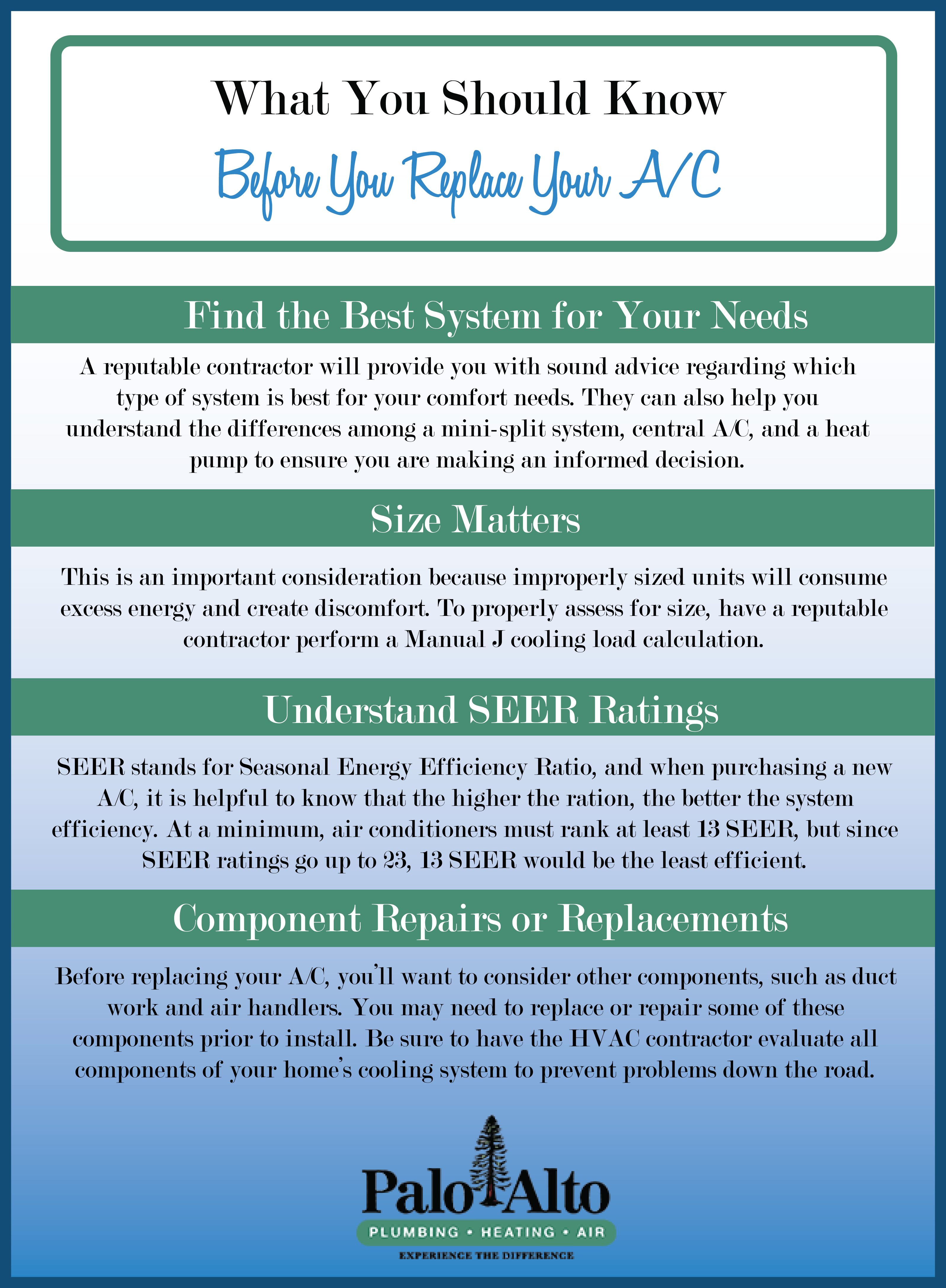
What You Should Know Before You Replace Your A/C

Are you considering whether or not your air conditioner could stand to be replaced/? Maybe your A/c has quit working as efficiently, or you’re after a more energy efficient unit and and you think now might be a great time to get a replacement.  Or, maybe you’ve never thought twice about your A/C and have no idea what you should do.

Whatever your reason for considering upgrading your air conditioner, you’ll want to be prepared with the correct information before making a decision. Check out this handy post to ensure that you are making the right choice when it comes to A/C replacement.

Advice Before Replacing Your Air Conditioner

Advice Replace Air Conditioner

Still Have Questions? Call Us Today!

If you’re still unsure whether a new air conditioner is right for you, we can help. At Palo Alto Plumbing, Heating and Air, our goal is to save homeowners money with better energy efficiency, exclusive savings on services, as well as financing and rebates. We don’t want finances to stand in between you and your comfort at home! Call us today to get in touch with an A/C expert to learn more about the variety of options you have when it comes to upgrading your home’s cooling system: 650-856-3400.

How Important Is It To Get The Right Size Of Heating And Cooling Equipment?

When it comes to purchasing heating and cooling equipment for your home, you need to realize that size really does matter. Installing equipment with a capacity that matches the home’s size will decrease energy usage while improving comfort for you and your family.

Home builders these days are constructing more energy efficient homes. The installation of double-pane windows, weather-stripping, insulation and caulking reduce heat gain during the summer and heat loss during the winter. This allows homeowners to purchase and install smaller systems than they needed in the past without sacrificing comfort.

Anyone who thinks bigger is better when purchasing a heating and cooling system should think again. Purchasing something that is too big for the space is the most common HVAC sizing mistake consumers make. An oversize HVAC system will produce large temperature swings making it difficult to maintain comfort. It will not run long enough to remove all the moisture from the air, which makes it feel clammy. In addition to being uncomfortable, high humidity can promote mold growth, which is a health hazard.

Residential Load Calculation is the Manual J method of HVAC sizing created and recommended by the Air Conditioning Contractors of America, or ACCA. Residential Duct Design is the Manual D method of HVAC sizing used when the system includes ducts.

Both manuals take into account a variety of factors that affect a home’s requirement for heating and cooling. These factors include the number of occupants, climate, house size, house shape, roof surface color, which way the house is oriented, air infiltration rates, the types of home appliances and lights giving off heat and ceiling, window and floor area.

An experienced estimator will calculate room volumes, estimate air leakage and check the R-value of the insulation. The process should include inspecting the condition of seals and insulation as well as duct distribution in a forced air system. The contractor should provide a written estimate for sizing the system, a contract and a written warranty on labor and equipment.

Purchasing the right size HVAC system is the best way to ensure your home is energy efficient and comfortable year round.

Follow us for access to more great articles on heating, air conditioning and home needs.

Fans Or A/C – Which Is Better?

Fans may not be the most advanced piece of technology but they continue to be in use in our modern world. In fact, it is probably due to their simplicity that they still enjoy such immense popularity. They consist of a plastic or metal blade, a motor, a protective casing, and a few button controls. As long as electricity is applied to the motor, the attached blade will spin rapidly. This movement causes the air around the device flow quickly from the back to the front, thus increasing circulation. The blast of wind does not lower room temperature but it does promote evaporative cooling as sweat dries from skin.

Air conditioners, on the other hand, are more complicated machines that seem to keep on rising in sophistication. They are composed of a compressor, a condenser, condensing coils, evaporative coils, refrigerant, a thermostat, a control panel, air filters, tubing, and many other parts. Sometimes they come as a singular unit and at other times they are separated into interior and exterior units. They use heat transfer primarily through the refrigerant’s movement across the system to lower the temperature in a room or even an entire building. The air truly feels cold wherever you go in the confined space.

Although A/Cs offer superior comfort, their energy consumption leaves much to be desired. Assuming moderate use in a residential setting, people are likely to spend thousands of dollars per year in utility bills just to keep them running. This can be quite a burden for many who have other priorities to attend to. Fans, despite their limited cooling capabilities, consume a comparatively miniscule amount of energy. In fact, their contribution to the annual utility bills may not even reach a hundred dollars with extensive usage patterns.

In regions where heat never reaches an oppressive level, fans may well be enough to get people through the summer. However, there is a point at which no amount of air circulation will do. Having an air conditioner is still the best bet in most cases. Homeowners can have fans or A/C or both to get the comfort and the savings at the same time. The cooling effect of fans makes it possible to set the A/C temperature higher so that they consume less energy.

Call us for all of your heating and air conditioning needs.

Should I Replace Or Repair My Equipment?

It can be difficult to decide whether it is best for you to repair or replace your equipment. There are many factors you have to consider before you make your decision. Below is a guide that will help you decide whether it is best to repair or replace your equipment:

The Age

The age of your equipment is one of the things you will need to think about when you are asking yourself, “Should I replace or repair my equipment? If your unit was built prior to 1992, replacement is most likely the better option. While replacing the unit is more expensive than having it repaired, you can actually save money by getting it replaced.

Newer air conditioners and furnaces are more energy-efficient than the ones in the past. In fact, you may be able to save 20 percent on your electric bill if you get a new unit.

The Cost

The cost is something else you will need to consider when you are deciding whether it is best to repair or replace the unit. Experts recommend that you have your equipment replaced if it is older than three-fourths of its life expectancy, and the cost of repairing it is more than one-third of the cost of replacing it.

For example, the average air conditioner lasts 10 to 15 years. If your air conditioner is over 10 years old, and it will cost $1,000 to repair, you may want to have it replaced. Replacing your unit can not only help you save money, but it can also help keep you more comfortable in your home.

Deciding whether you should have your equipment repaired or replaced can be a difficult decision because each option has its pros and cons. The cost and the age of your equipment are two of the main factors you should consider when you are deciding whether to have your equipment repaired or replaced. It is also a good idea to have a qualified technician take a look at your equipment. Every situation is different, so it makes sense to call a professional. Call us for your home HVAC needs.